

 By Nich Osborn · November 18, 2026
Is “Ozempic face” real? It is a thing that can happen to folks who drop a lot of weight, but it’s more of a #hashtag than a medical diagnosis and, as it turns out, not specific to Ozempic. But what is it exactly, who does it affect, and can it be avoided? (TL;DR: it’s a loss of facial fat, it affects some groups more than others, and we’re not sure yet.)
The term “Ozempic face” started popping up in early 2023, soon after the popularity of GLP-1 drugs exploded when it seemed a lot of people were talking about (and taking) them. It describes a person’s face that loses some of its fullness after starting GLP-1s in a way that looks deflated or gaunt.
The shape of your face at any given time depends on a lot of things, like your bone structure, facial muscles, skin, and fat. It’s these multiple pads of body fat in particular that contribute to the fullness of your face, especially around the temples, cheeks, jawline, eyes, and mouth. If you lose a lot of weight, these fat pads can shrink too, and if your skin doesn’t tighten to match, your face can start looking hollow as your skin starts to sag.
Understandably, prospective GLP-1 enjoyers started getting worried that a slimmer waistline could come at the cost of a gaunt face, and it wasn’t long before the studies began. Some of these studies also tried to look at how much facial fat was being lost, and if GLP-1s were specifically causing more facial fat reduction than other methods of losing weight. After all, some early lab research has suggested GLP-1s directly interact with fat tissue, so it’s not a stretch to think there might be a deeper connection there even if it’s too early to make the connection with humans.
The best measurement so far is a 2025 study that compared before-and-after scans of 20 people taking GLP-1 drugs to see how much the midface shrank as overall body weight went down. This group (median age of 54; average 24 pounds down) lost around 9% of total midface volume, which gave a rough correlation (a trend across the group) of 7% less volume per 22 pounds of body weight lost, and the fat layer just under the skin shrank by about 11%.
That’s a pretty big change, but far less than an earlier 2023 conference presentation that reported semaglutide shrinking that same cheek fat layer by around 70%. That presentation set off some alarm bells, but it’s worth noting it only looked at five patients, who lost a whopping 21% of their total body weight, an unusually large result. It also had no non-GLP-1 group that lost similar amounts of weight to compare those five patients to, so we can’t tell if the drug itself made the difference.
As for whether GLP-1 drugs specifically target the face more than other weight-loss methods, recent research suggests that they probably don’t. A 2025 systematic review said the evidence for facial fat targeting “is lacking.” One 2026 review of 46 reports said the evidence for Ozempic face was mostly due to generic “weight-loss-associated deflation,” and another 2026 review of 44 articles said the phenomenon was best understood “not as a drug-specific facial disease.” Doctors have also been seeing the same facial changes for decades after weight-loss surgery and major dieting. And so far, that lab link between GLP-1s and fat tissue hasn’t shown up in people’s faces.
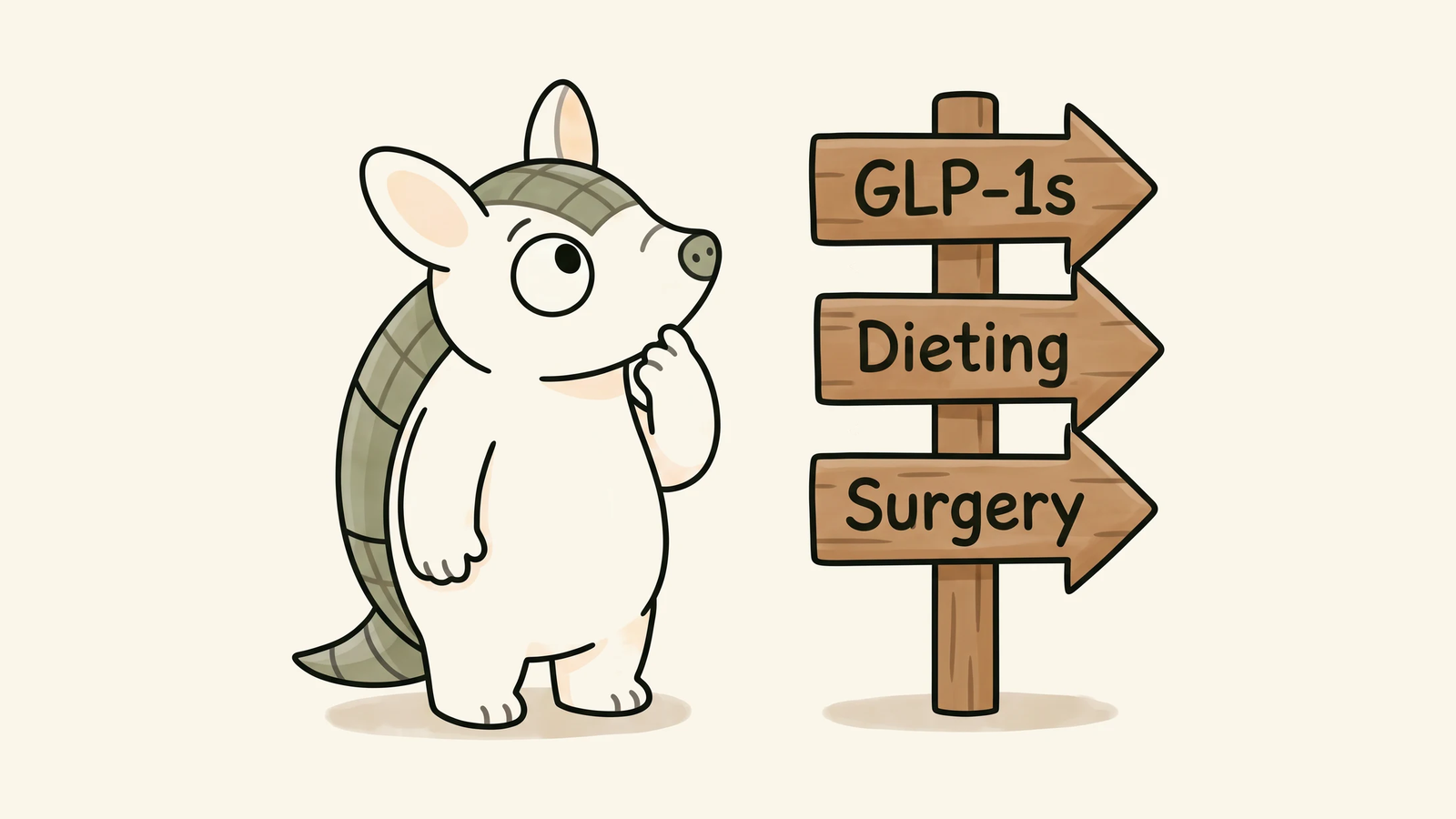
GLP-1s, dieting, and surgery all lead the same way: the weight loss itself.
So if it’s not GLP-1s specifically, what are the major factors that cause Ozempic face? Basically, it comes down to how much weight you lose and how old you are, and possibly how fast you lose it. GLP-1 drugs like semaglutide just happen to be really good at the first part. The more weight you lose, the more overall fat you lose, and the more of that will come from your face. If you lose it quickly like people on GLP-1s sometimes do, doctors think it can give the skin over that fat less time to adjust, making it looser (though this hasn’t been proven yet). On top of that, older skin has less collagen than younger skin, meaning the skin is less able to bounce back when things underneath it change.
And how likely is it to happen? In a 2026 survey (with no industry funding, which is always worth checking) of 1,226 patients in a virtual heart and metabolic care program, about 1 in 8 patients who lost less than 10% of their body weight said their face looked less full, compared to half of patients who lost over 20%. And people on GLP-1s did say they noticed more face changes than people who lost a similar amount of weight a different way. That said, this survey didn’t track how fast people lost the weight, so it couldn’t tell whether the difference came from the drug or simply losing weight quickly. (And as a personal hunch, I’d bet people starting GLP-1s for the first time probably check the mirror more often, which could make them more likely to notice small facial differences than those who don’t. At least one researcher has raised the same idea.)
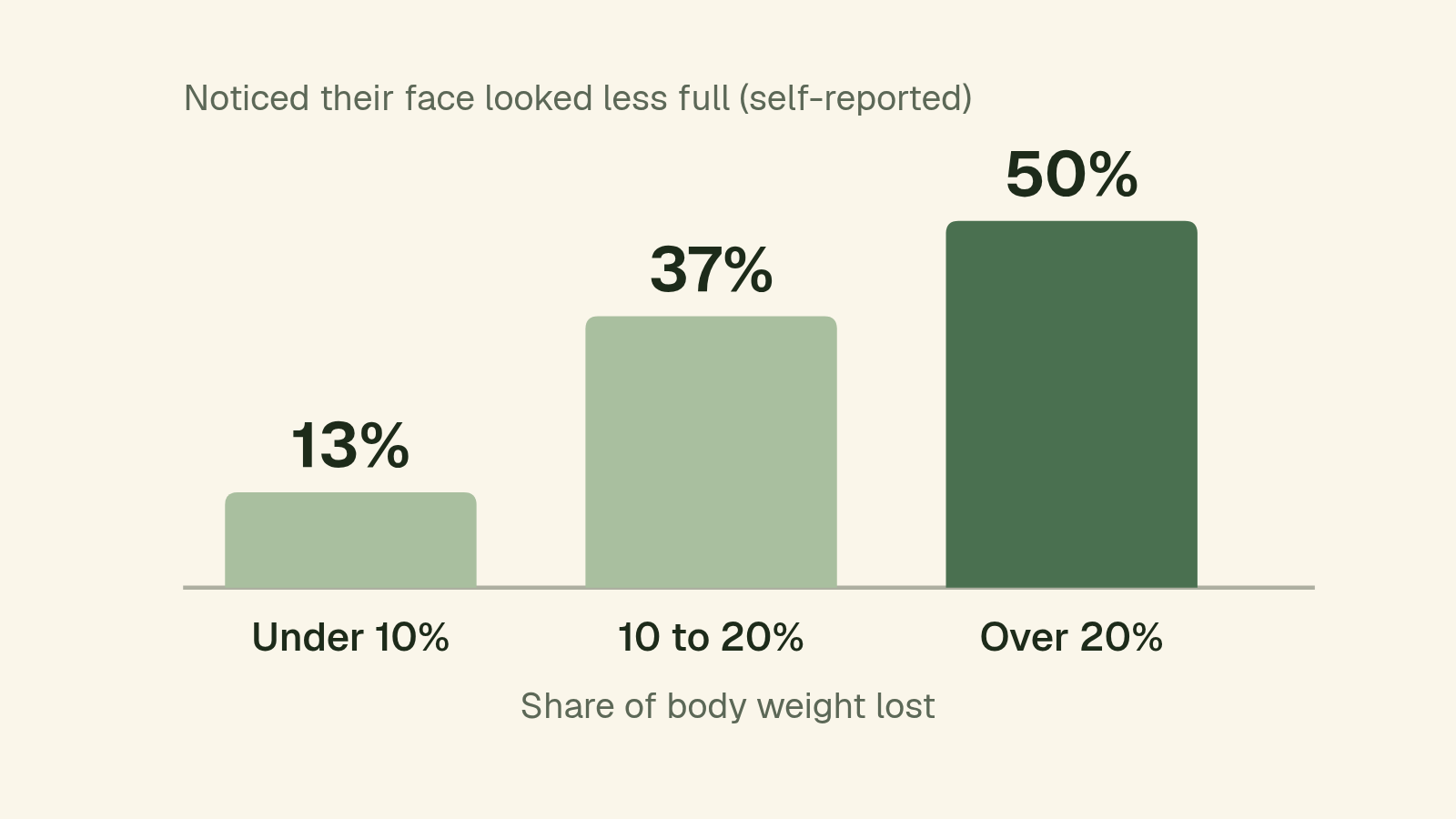
Share of patients who said their face looked less full, by how much weight they lost. Self-reported; Rao et al., 2026.
Since GLP-1 research is still catching up to the hype, there’s a lot we don’t know yet, such as whether losing weight more slowly protects your face, whether fullness comes back if you regain weight, or whether one GLP-1 is linked to this more than another. There are still more studies planned to look into this, including one that aims to use 3D scans of identical twins coming up, but we’ll have to wait until the results come in.
So in a nutshell: the look is real, because losing a lot of body fat means losing some from your face too, but the research so far points to the weight loss itself, not something unique to the drug. Can you avoid it? Nobody’s tested that yet, so there’s no proven way to prevent it. If changes in your face are bothering you, please don’t stop or change your medication on your own. Figuring out how to handle it safely is, as always, a question for you and your provider.
Sources
- Sharma RK, Vittetoe KL, Barna AJ, et al. Radiographic midfacial volume changes in patients on GLP-1 agonists. Otolaryngol Head Neck Surg. 2025;173(2):360-366. https://doi.org/10.1002/ohn.1209
- Yoo K-H. Glucagon-like peptide-1 receptor agonist-associated facial changes: a comprehensive review of pathophysiology, clinical manifestations, risk factors, prevention, and management. Aesthet Surg J. 2026. https://doi.org/10.1093/asj/sjag230
- Daneshgaran G, Shauly O, Gould DJ. “Ozempic face” in plastic surgery: a systematic review of the literature on GLP-1 receptor agonist mediated weight loss and analysis of public perceptions. Aesthet Surg J Open Forum. 2025;7:ojaf056. https://doi.org/10.1093/asjof/ojaf056
- Lee KWA, Chan KWL, Lee CH, Wong THS. Ozempic face: an update and critical review. J Cosmet Regen Med. 2026;1(2):19. https://doi.org/10.65381/jcrm.2026.01010019
- Rao S, Midura I, Mangual KPS, et al. Skin impacts and tradeoffs of GLP-1 therapy: improved patient-reported outcomes of inflammatory skin disease in the era of “Ozempic face”. Dermatol Ther. 2026;16(9):4749-4760. https://doi.org/10.1007/s13555-026-01882-z
- Jafar AB, Jacob J, Kao WK, Ho T. Soft tissue facial changes following massive weight loss secondary to medical and surgical bariatric interventions: a systematic review. Aesthet Surg J Open Forum. 2024;6:ojae069. https://doi.org/10.1093/asjof/ojae069
- Comparing facial aging between identical twins with 3D imaging. ClinicalTrials.gov NCT07760532. https://clinicaltrials.gov/study/NCT07760532
- Mahase E. GLP-1 agonists: US sees 700% increase over four years in number of patients without diabetes starting treatment. BMJ. 2024;386:q1645. https://doi.org/10.1136/bmj.q1645
- Swift A, Liew S, Weinkle S, Garcia JK, Silberberg MB. The facial aging process from the “inside out”. Aesthet Surg J. 2021;41(10):1107-1119. https://doi.org/10.1093/asj/sjaa339
- Rohrich RJ, Pessa JE. The fat compartments of the face: anatomy and clinical implications for cosmetic surgery. Plast Reconstr Surg. 2007;119(7):2219-2227. https://doi.org/10.1097/01.prs.0000265403.66886.54
- Paschou IA, Sali E, Paschou SA, et al. GLP-1RA and the possible skin aging. Endocrine. 2025;89(3):680-685. https://doi.org/10.1007/s12020-025-04293-w
- Wilding JPH, Batterham RL, Calanna S, et al. Once-weekly semaglutide in adults with overweight or obesity. N Engl J Med. 2021;384(11):989-1002. https://doi.org/10.1056/NEJMoa2032183
- Sharp G. Response by Sharp to: “Ozempic face” in plastic surgery: a systematic review… by Daneshgaran et al. Aesthet Surg J Open Forum. 2026;8:ojag080. https://doi.org/10.1093/asjof/ojag080
Nich Osborn